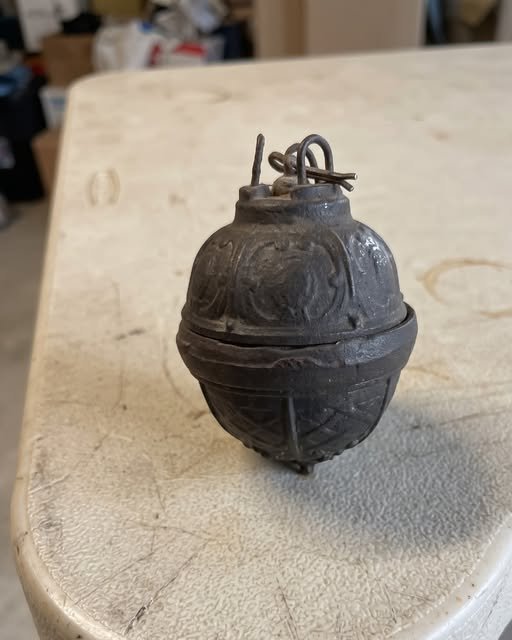
Antique Cast-Iron Pinecone Weights: The Hidden “Engine” Inside a Black Forest Cuckoo Clock
If you’ve ever looked at an old Black Forest cuckoo clock, you may have noticed the distinctive pinecone-shaped weights hanging beneath the wooden case.
They may look like simple antique decorations, but they serve an important purpose: they provide the energy that drives the clock’s mechanical movement.
🌲 What Are the Pinecone Weights?
The weights are typically made from metal, often cast iron, and are shaped to resemble pinecones.
Their distinctive appearance fits naturally with the forest-inspired designs associated with traditional Black Forest clockmaking.
But their purpose isn’t merely decorative.
They are part of the clock’s power system.
⚙️ How Do Cuckoo Clock Weights Work?
The basic principle is surprisingly simple: gravity.
A chain runs through the clock’s movement and is connected to a hanging weight. As the weight slowly moves downward, gravity provides the energy needed to operate the clock.
Inside the case, gears and other mechanical components use that energy to keep the clock running.
In many traditional clocks, separate weight-driven mechanisms can also operate the cuckoo call and musical features.
🔗 Why Are the Weights Attached to Chains?
The chains allow the weights to move downward gradually while transferring their energy to the clock mechanism.
When the weights reach the bottom of their travel, the clock needs to be wound.
Instead of turning a key like some other mechanical clocks, many chain-driven cuckoo clocks are wound by carefully pulling the chains so the weights return upward.
🕰️ Why Are They Shaped Like Pinecones?
The pinecone shape is strongly associated with traditional Black Forest cuckoo clocks.
Black Forest clockmakers often incorporated forest and nature motifs into their designs, and the pinecone-shaped weights became a recognizable visual feature.
Their shape also provides a practical form for a hanging weight that can be comfortably handled when winding the clock.
🏡 A Piece of Traditional Clockmaking
The Black Forest region of Germany became famous for its clockmaking traditions.
Wooden cases, carved forest scenes, animals, leaves, and other natural elements became characteristic features of many clocks produced in the region.
The weights underneath the clock are therefore part of both the function and visual identity of these traditional timepieces.
🔧 Do the Weights Really Power the Clock?
Yes.
The weights store gravitational potential energy when they are lifted. As they descend, that energy is transferred through the clock’s mechanical movement.
The clock’s gears regulate this energy so that it is released gradually rather than all at once.
This controlled movement is what allows a mechanical clock to keep running.
🔔 What Happens When the Weights Reach the Bottom?
Eventually, the weights descend as far as the chains allow.
At that point, the clock needs to be wound again.
For a traditional chain-driven cuckoo clock, this usually means gently pulling the free end of each chain downward to raise the corresponding weight.
The exact winding procedure can vary between clock mechanisms, so antique clocks should be handled carefully.
🧐 Why Are Antique Weights Interesting to Collectors?
Original clock weights can tell you something about the history and construction of an antique clock.
Collectors may look at:
Shape
Size
Weight
Surface patina
Construction
Chain attachment
Maker or clock movement
Overall condition
However, the weights alone aren’t enough to determine the age or value of a cuckoo clock.
The movement, case, markings, condition, and provenance are all important.
⚠️ Don’t Assume Every Pinecone Weight Is Antique
Modern reproduction cuckoo clocks can also use pinecone-shaped weights.
An aged appearance or dark patina doesn’t automatically prove that a weight is genuinely old.
If you’re trying to identify an antique clock, it’s better to examine the complete clock and its mechanical movement rather than relying on one component.
🌲 More Than Decoration
Those little metal pinecones hanging beneath an old cuckoo clock have a fascinating job.
They are essentially the clock’s energy source.
Every slow movement downward is transferring energy into the mechanical mechanism, keeping the hands moving and, in traditional designs, helping operate the familiar cuckoo and musical functions.
❓ Did You Know?
The next time you see an old Black Forest cuckoo clock, look underneath it.
Those decorative-looking pinecones aren’t just ornaments—they’re an essential part of the clock’s ingenious mechanical design. 🕰️🌲
To provide the best experiences, we use technologies like cookies to store and/or access device information. Consenting to these technologies will allow us to process data such as browsing behavior or unique IDs on this site. Not consenting or withdrawing consent, may adversely affect certain features and functions.
Functional
Always active
The technical storage or access is strictly necessary for the legitimate purpose of enabling the use of a specific service explicitly requested by the subscriber or user, or for the sole purpose of carrying out the transmission of a communication over an electronic communications network.
Preferences
The technical storage or access is necessary for the legitimate purpose of storing preferences that are not requested by the subscriber or user.
Statistics
The technical storage or access that is used exclusively for statistical purposes.The technical storage or access that is used exclusively for anonymous statistical purposes. Without a subpoena, voluntary compliance on the part of your Internet Service Provider, or additional records from a third party, information stored or retrieved for this purpose alone cannot usually be used to identify you.
Marketing
The technical storage or access is required to create user profiles to send advertising, or to track the user on a website or across several websites for similar marketing purposes.