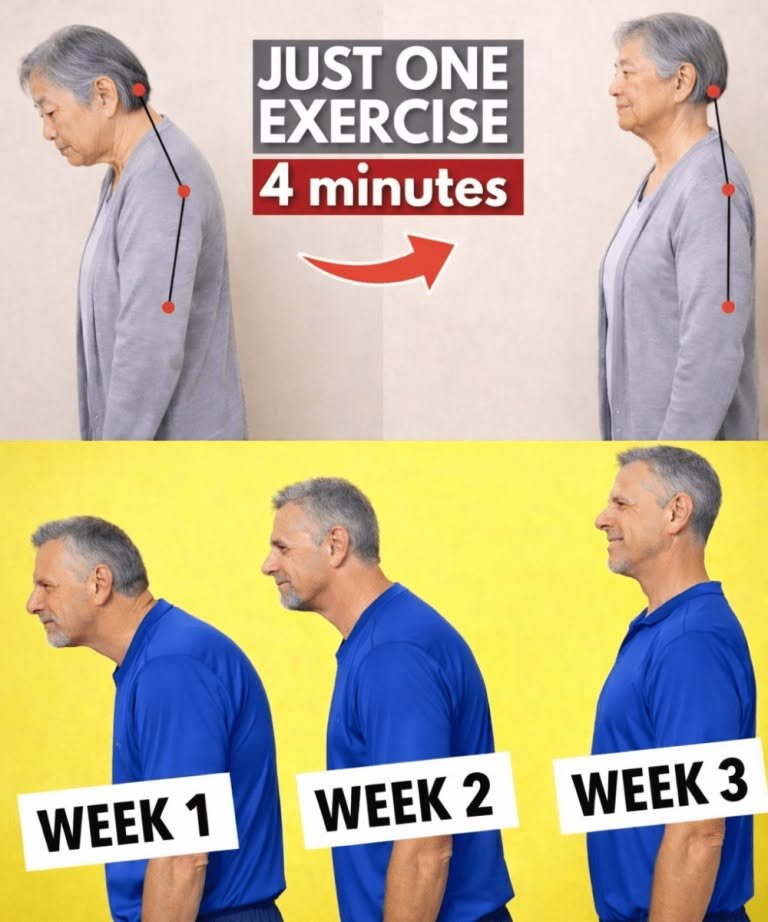
How to Improve Forward Head Posture After 60: A Gentle 4-Minute Daily Routine
Forward head posture can become more noticeable with age, especially when we spend long periods looking down at phones, reading, watching television, or sitting at a desk.
The good news is that gentle, consistent exercises may help improve head and neck alignment, strengthen supporting muscles, and reduce some types of neck discomfort. Research has found that therapeutic exercise can improve measures of forward head posture and may also help with neck pain.
You don’t need an intense workout to get started. A few minutes of controlled movement each day can be a practical addition to a healthy mobility routine.
Important: This routine is for general wellness and is not a substitute for medical care. If you have significant neck pain, dizziness, numbness, weakness, recent injury, or another medical condition, speak with a healthcare professional before exercising.
What Is Forward Head Posture?
Forward head posture occurs when the head sits farther forward than its ideal position over the shoulders.
It can be associated with:
Neck and upper-back discomfort
Muscle tightness
Rounded shoulders
Reduced neck mobility
Increased strain during prolonged sitting
Forward head posture is common, but it doesn’t necessarily mean that something is seriously wrong. Posture can change over time, and targeted exercise may help improve alignment and function.
Can Exercise Really Help After 60?
Yes, gentle exercise can be useful.
A systematic review and meta-analysis found strong evidence that therapeutic exercises can improve the craniovertebral angle, a commonly used measurement of forward head posture. The review also found moderate evidence that exercise may improve neck pain.
Research specifically involving older adults has also found that exercise-based interventions can improve certain measures of posture and physical function.
However, posture generally doesn’t change permanently after a single session. Think of a short routine as a daily habit that supports gradual improvement rather than a quick fix.
The Gentle 4-Minute Routine
Perform these movements slowly and comfortably. You should never force your neck into a painful position.
1. Gentle Chin Tuck — 1 Minute
Sit upright with your shoulders relaxed.
Look straight ahead and gently draw your chin backward, as though you’re trying to make a small “double chin.”
Don’t look down.
Hold the position for about 3–5 seconds, then relax.
Repeat slowly for about one minute.
Focus: Keep the movement small and controlled rather than pushing your head backward forcefully.
2. Shoulder Blade Squeeze — 1 Minute
Sit or stand comfortably.
Gently draw your shoulder blades backward and slightly downward.
Hold for 3–5 seconds, then relax.
Repeat several times.
Keep your shoulders relaxed instead of shrugging them toward your ears.
Focus: Imagine you’re gently bringing your shoulder blades toward each other.
3. Wall Posture Reset — 1 Minute
Stand comfortably with your back near a wall.
Keep your feet in a comfortable position and gently lengthen your spine.
Bring your shoulders into a relaxed position.
If comfortable, lightly draw your chin backward.
Hold for a few seconds, relax, and repeat.
Don’t force your head against the wall.
Focus: Think “tall and relaxed” rather than “straighten as hard as possible.”
4. Gentle Neck Mobility — 1 Minute
Sit comfortably.
Slowly turn your head toward the right, returning to the center, then toward the left.
Next, gently look slightly upward and return to neutral.
Keep every movement within a comfortable range.
Avoid fast circles or forcing the neck into extreme positions.
Focus: Smooth, pain-free movement.
How Often Should You Do It?
The biggest benefit comes from consistency.
Try this gentle routine once a day and combine it with regular movement throughout the day. If you spend a lot of time sitting, take short movement breaks rather than remaining in the same position for hours.
Research on forward head posture generally examines exercise programs lasting weeks rather than only a few minutes, so the 4-minute routine should be viewed as a convenient starting habit—not a promise of dramatic results in four minutes.
Simple Habits That Can Support Better Posture
Your everyday habits matter too.
Keep Screens Closer to Eye Level
If you constantly look down at a phone or tablet, try raising the screen closer to eye level.
Change Positions Regularly
Even a good sitting position can become uncomfortable if you stay there too long.
Stand up, walk around, or gently move your shoulders and neck throughout the day.
Strengthen More Than Just the Neck
Posture involves the neck, shoulders, upper back, and trunk. Exercise programs that combine strengthening and stretching may be helpful for improving postural alignment.
Don’t Force Your Posture
Trying to hold your head rigidly upright all day can create unnecessary tension.
Instead, aim for a comfortable, relaxed position that you can maintain naturally.
When Should You Stop?
Stop the exercise if it causes sharp or increasing pain, significant dizziness, unusual symptoms, or other concerning sensations.
If you experience persistent neck pain, numbness, weakness, balance problems, or symptoms following an injury, consult a qualified healthcare professional.
The Bottom Line
Forward head posture can be influenced by habits, muscle strength, mobility, and other factors. Age doesn’t mean you have to stop working on comfortable movement and posture.
A simple 4-minute routine of gentle chin tucks, shoulder-blade exercises, posture practice, and neck mobility can be an easy place to start.
The goal isn’t perfect posture. It’s comfortable movement, better awareness, and consistent healthy habits.
With regular practice and appropriate guidance, gentle exercise may help improve posture and neck function over time.
To provide the best experiences, we use technologies like cookies to store and/or access device information. Consenting to these technologies will allow us to process data such as browsing behavior or unique IDs on this site. Not consenting or withdrawing consent, may adversely affect certain features and functions.
Functional
Always active
The technical storage or access is strictly necessary for the legitimate purpose of enabling the use of a specific service explicitly requested by the subscriber or user, or for the sole purpose of carrying out the transmission of a communication over an electronic communications network.
Preferences
The technical storage or access is necessary for the legitimate purpose of storing preferences that are not requested by the subscriber or user.
Statistics
The technical storage or access that is used exclusively for statistical purposes.The technical storage or access that is used exclusively for anonymous statistical purposes. Without a subpoena, voluntary compliance on the part of your Internet Service Provider, or additional records from a third party, information stored or retrieved for this purpose alone cannot usually be used to identify you.
Marketing
The technical storage or access is required to create user profiles to send advertising, or to track the user on a website or across several websites for similar marketing purposes.