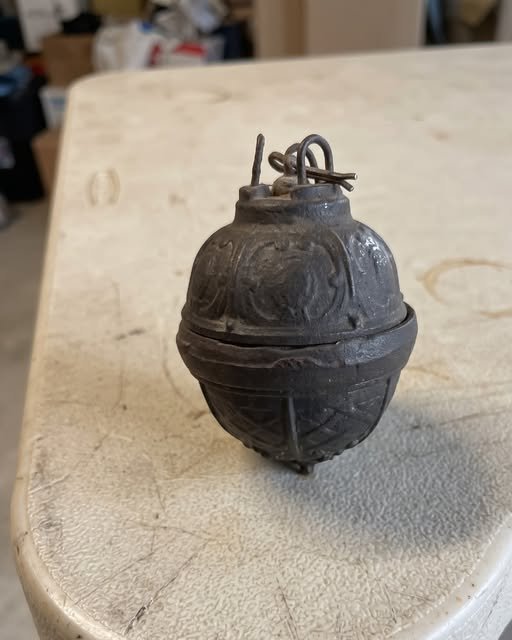
Mystery Solved: What Is This Heavy, Egg-Shaped Metal Object Found in an Old Basement?
If you have ever explored the basement or garage of an older home, you know the thrill of uncovering a strange, unidentifiable object. Recently, a fascinating mystery surfaced involving a heavy, egg-shaped metal artifact weighing around 2.5 kilograms, complete with a mysterious rattle inside.
If you have found something similar in an old German home or a vintage property, you are not alone. Let’s dive into the history and purpose of this intriguing metallic egg.
The Reveal: An Antique Cast Iron Counterweight
This unusual object is most likely an antique cast iron counterweight, historically used for hanging oil or kerosene lamps, or potentially a vintage industrial plumb bob from the late 19th or early 20th century.
During the Victorian era and the early 1900s, before the widespread adoption of modern electrical wiring, homes relied on hanging oil lamps for illumination. These lamps were often suspended from ceilings using pulley systems.
The Purpose of the Heavy Metal Egg
You might wonder why a simple lamp would need a 2.5 kg metal egg. The design was highly practical and served several crucial functions:
Height Adjustment: The weight acted as a counterbalance on a pulley system, allowing homeowners to easily raise and lower the lamp for lighting, extinguishing, or refilling without needing a ladder.
Stability: The substantial weight kept the suspension chain taut, preventing the open-flame lamp from swinging dangerously in drafts.
Decorative Craftsmanship: Unlike modern, purely functional weights, these historical pieces were often beautifully cast with segmented patterns or embossed details, blending utility with Victorian-era aesthetics.
Why Does It Rattle?
The rattling sound you hear when moving the object is a classic hallmark of its age and construction. There are a few common reasons for this:
Separated Seams: These weights were often made by casting two halves and joining them. Over a century of temperature changes and handling can cause the internal seam to loosen slightly.
Internal Debris: Small pieces of rust, dried lubricant, or a loose internal pin from the original casting process can break free over time, creating that distinct rattling noise.
Hollow Construction: To achieve the right weight-to-size ratio without using solid, prohibitively expensive metal, many of these were cast with a hollow core.
Is It Valuable?
While it may not be a hidden treasure chest of gold, vintage industrial decor is incredibly popular right now. Antique counterweights, plumb bobs, and cast iron artifacts are highly sought after by collectors, interior designers, and history enthusiasts.
A well-preserved piece with clear, decorative segmentation can make a fantastic conversation piece, a unique bookend, or a striking addition to a rustic or industrial-themed room.
What to Do With Your Find
If you have discovered this object in your home, clean it gently with a dry cloth to remove surface dust. Avoid harsh chemicals or wire brushes, as these can damage the historical patina that gives the piece its character and value.
Have you ever stumbled across a mysterious vintage object in an old home? Share your own basement discoveries in the comments below, and let us know if this explanation solved your metallic mystery!
To provide the best experiences, we use technologies like cookies to store and/or access device information. Consenting to these technologies will allow us to process data such as browsing behavior or unique IDs on this site. Not consenting or withdrawing consent, may adversely affect certain features and functions.
Functional
Always active
The technical storage or access is strictly necessary for the legitimate purpose of enabling the use of a specific service explicitly requested by the subscriber or user, or for the sole purpose of carrying out the transmission of a communication over an electronic communications network.
Preferences
The technical storage or access is necessary for the legitimate purpose of storing preferences that are not requested by the subscriber or user.
Statistics
The technical storage or access that is used exclusively for statistical purposes.The technical storage or access that is used exclusively for anonymous statistical purposes. Without a subpoena, voluntary compliance on the part of your Internet Service Provider, or additional records from a third party, information stored or retrieved for this purpose alone cannot usually be used to identify you.
Marketing
The technical storage or access is required to create user profiles to send advertising, or to track the user on a website or across several websites for similar marketing purposes.