Why Your Hands Fall Asleep: The Warning Signs of Nerve Compression You Shouldn’t Ignore
We’ve all experienced it: you wake up in the morning with a hand that feels completely dead, or you shake out a prickling, tingling sensation after leaning on your arm for too long. That “pins and needles” feeling—medically known as paresthesia—is your nervous system’s way of telling you something is interrupting the flow of information between your brain and your hand.
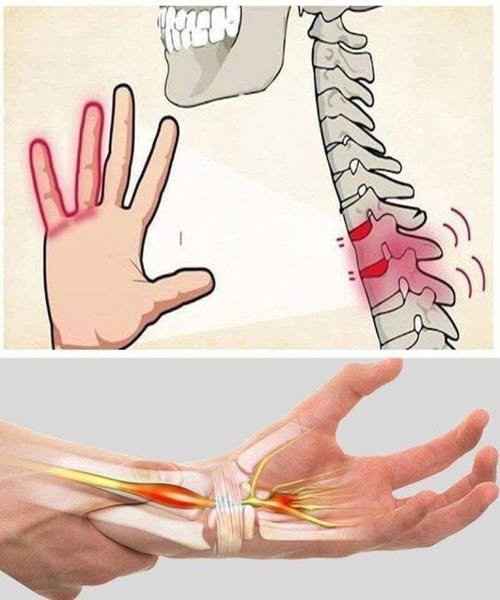
While it’s usually harmless and temporary, if your hands are falling asleep frequently, it’s a clear sign that you might be dealing with an underlying issue. The illustrations above highlight two of the most common culprits: nerve compression in the neck and nerve compression in the wrist. Here’s what your body might be trying to tell you.
1. The Neck Connection: Cervical Radiculopathy
Look at the top illustration. It shows a hand with the thumb, index, and middle fingers highlighted, alongside an image of the cervical spine with a nerve root highlighted in red. This is a classic depiction of cervical radiculopathy.
Your spinal cord sends nerve roots out between the vertebrae in your neck to supply sensation and movement to your arms and hands. When one of these nerve roots becomes compressed or irritated—often due to a herniated disc, bone spurs, or arthritis—it can cause symptoms that radiate down your arm.
Symptoms to watch for:
A tingling or “electric shock” sensation that travels from your neck, down your shoulder, and into your hand.
Numbness or weakness in specific fingers, depending on which nerve root is affected.
Pain that worsens when you cough, sneeze, or tilt your head back.
2. The Wrist Connection: Carpal Tunnel Syndrome
The bottom illustration shows the anatomy of the wrist, highlighting the median nerve passing through a narrow tunnel of ligaments and bones. This is the classic mechanism behind Carpal Tunnel Syndrome (CTS), one of the most common causes of hand numbness.
When the tissues around the median nerve become swollen, they press against the nerve, disrupting its function. CTS typically causes numbness and tingling in the thumb, index finger, middle finger, and half of the ring finger—exactly the fingers highlighted in the top image.
Classic signs of Carpal Tunnel Syndrome:
Symptoms are often worse at night, frequently waking you from sleep.
You find yourself shaking or “flicking” your hand to relieve the numbness.
Weakness in your grip, making it difficult to hold a cup or button a shirt.
Other Potential Causes of Hand Numbness
While nerve compression in the neck or wrist is common, several other conditions can cause your hands to fall asleep:
Ulnar Nerve Compression: This nerve runs along the inner side of your arm to your pinky and ring fingers. It’s most often compressed at the elbow (cubital tunnel syndrome), often caused by leaning on your elbows for long periods.
Diabetes: Over time, high blood sugar can damage nerves throughout the body, a condition called diabetic neuropathy. This often affects the feet first but can also cause numbness and tingling in the hands.
Vitamin B12 Deficiency: Lack of this essential vitamin can lead to nerve damage and numbness.
Hypothyroidism: An underactive thyroid can cause fluid retention that puts pressure on nerves.
🚨 When to Seek Immediate Medical Care
Most hand numbness is not a medical emergency. However, you should call 911 or seek immediate medical attention if the numbness is accompanied by any of the following, as they can be signs of a stroke:
Sudden weakness or paralysis, especially on one side of the body
Confusion or trouble speaking
Sudden, severe headache
Dizziness or loss of balance
Numbness that spreads to your face or leg
💡 When to See a Doctor
It’s a good idea to schedule an appointment with a healthcare provider if your hand numbness:
Is persistent, getting worse, or happening more frequently.
Wakes you up at night or is present when you wake up.
Starts to affect your grip strength or makes you drop things.
Is accompanied by pain in your arm, neck, or shoulder.
A doctor can perform a physical exam and may order tests like nerve conduction studies or an MRI to pinpoint the cause and recommend the right treatment, which may include physical therapy, wrist splints, or anti-inflammatory medications.
The Bottom Line
Your hands falling asleep is your body’s built-in alarm system. Don’t ignore it. By paying attention to when and where the numbness occurs, you can help your doctor identify the root cause and protect your nerve health before permanent damage occurs.
Disclaimer: This article is for informational purposes only and is not a substitute for professional medical advice, diagnosis, or treatment. Always seek the advice of your physician or another qualified health provider with any questions you may have regarding a medical condition.
To provide the best experiences, we use technologies like cookies to store and/or access device information. Consenting to these technologies will allow us to process data such as browsing behavior or unique IDs on this site. Not consenting or withdrawing consent, may adversely affect certain features and functions.
Functional
Always active
The technical storage or access is strictly necessary for the legitimate purpose of enabling the use of a specific service explicitly requested by the subscriber or user, or for the sole purpose of carrying out the transmission of a communication over an electronic communications network.
Preferences
The technical storage or access is necessary for the legitimate purpose of storing preferences that are not requested by the subscriber or user.
Statistics
The technical storage or access that is used exclusively for statistical purposes.The technical storage or access that is used exclusively for anonymous statistical purposes. Without a subpoena, voluntary compliance on the part of your Internet Service Provider, or additional records from a third party, information stored or retrieved for this purpose alone cannot usually be used to identify you.
Marketing
The technical storage or access is required to create user profiles to send advertising, or to track the user on a website or across several websites for similar marketing purposes.