The Ostrich Effect: Why We Avoid Information We Don’t Want to Hear
Have you ever avoided checking your bank balance because you were worried about what you’d see? Or ignored an important message because you knew it might contain unpleasant news?
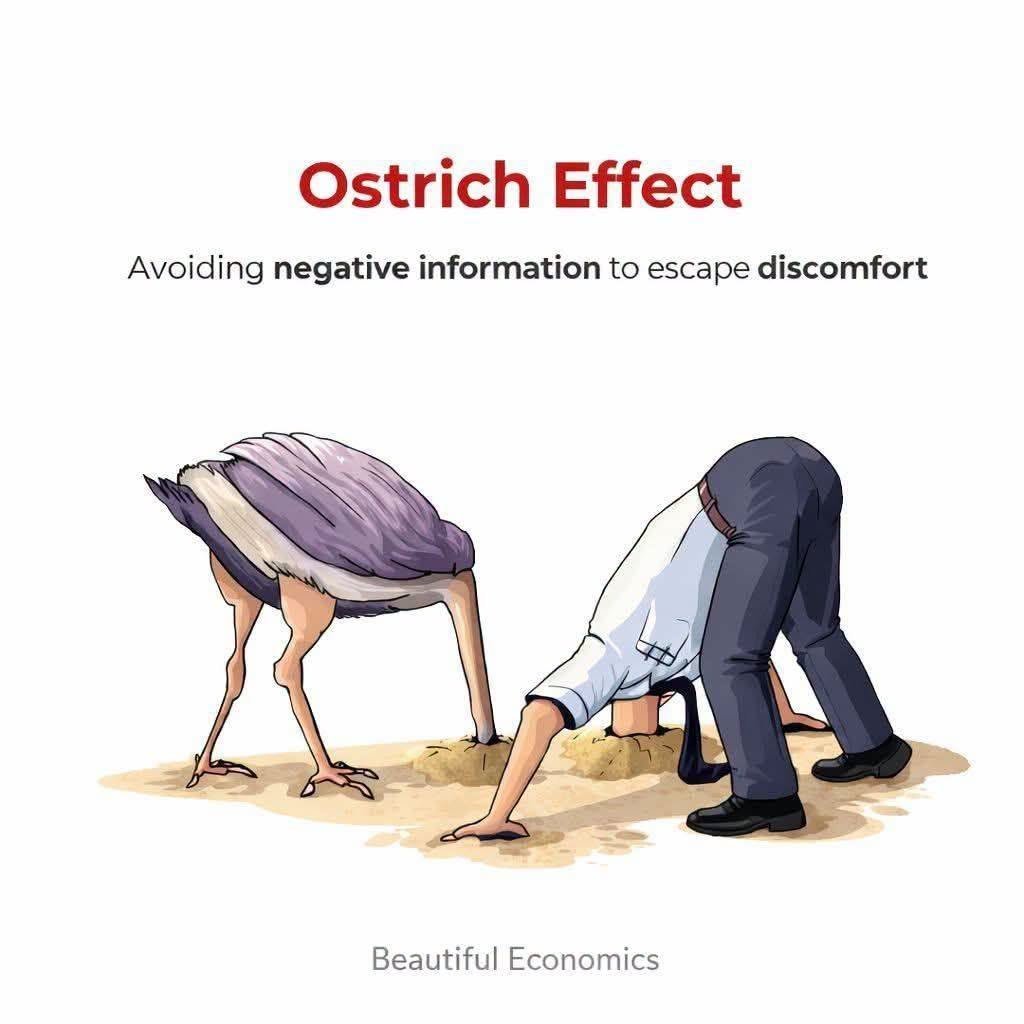
This behavior has a name: the Ostrich Effect.
The term describes a tendency to avoid information that may cause anxiety, discomfort, or emotional distress—even when knowing that information could help us make better decisions.
📌 What Is the Ostrich Effect?
The Ostrich Effect is a behavioral pattern in which people deliberately avoid negative or unpleasant information.
The name comes from the popular metaphor that an ostrich buries its head in the sand when it senses danger. In reality, ostriches don’t behave this way, but the metaphor is useful for describing how people sometimes respond to uncomfortable information.
For example, someone might:
Avoid checking their bank account when they’re worried about spending
Ignore an important email because they expect bad news
Put off making a medical appointment because they’re afraid of the result
Avoid looking at a difficult assignment because it feels overwhelming
Stop following news about a stressful situation
Delay dealing with an uncomfortable personal problem
The common factor is information avoidance.
🧠 Why Do People Avoid Unpleasant Information?
Avoiding uncomfortable information can provide temporary emotional relief.
When we expect information to be negative, checking it may create feelings such as:
Anxiety
Fear
Stress
Embarrassment
Uncertainty
Disappointment
Ignoring the information can therefore feel easier in the short term.
The problem is that avoidance doesn’t necessarily make the underlying situation disappear.
🔄 The Ostrich Effect and Short-Term Relief
Imagine receiving a message that you know requires an important response.
You might think:
“I’ll deal with it later.”
For a moment, you feel relieved because you don’t have to confront the problem.
But later, the situation may become more stressful because you’ve had additional time to worry about it.
This can create a cycle:
Unpleasant information → avoidance → temporary relief → delayed consequences → increased stress → more avoidance
Recognizing this pattern can be the first step toward changing it.
💰 Examples of the Ostrich Effect in Everyday Life
Financial Decisions
Someone who is worried about their finances may avoid checking account statements or reviewing bills.
Although avoiding the information may feel comforting temporarily, knowing the actual situation can make it easier to plan.
Health Information
People sometimes postpone routine appointments or ignore symptoms because they’re afraid of what a healthcare professional might say.
Avoiding information doesn’t guarantee a better outcome. When health concerns arise, seeking appropriate professional advice can be important.
Work and School
A student may avoid looking at a difficult assignment because it feels overwhelming.
Similarly, someone at work might avoid opening an email because they expect criticism.
Breaking a large task into smaller steps can make it easier to face.
📱 Does Social Media Make Information Avoidance Easier?
Modern technology gives us enormous amounts of information, but it also makes avoidance easy.
We can:
Close an article
Mute a conversation
Ignore notifications
Unsubscribe from uncomfortable updates
Stop checking certain accounts
Sometimes taking a break from stressful information is perfectly reasonable.
The issue arises when avoidance prevents us from dealing with information that is genuinely important.
🧩 Ostrich Effect vs. Healthy Information Boundaries
Not every decision to avoid information is unhealthy.
Constant exposure to upsetting news can be stressful, and choosing when and how often to consume news can be a healthy boundary.
The important question is:
Am I taking a deliberate break, or am I avoiding information because I’m afraid of what it might tell me?
That distinction can help you understand your behavior.
✅ How to Reduce Information Avoidance
If you notice yourself avoiding something important, try a few simple strategies.
1. Start With One Small Step
You don’t have to solve everything immediately.
Open the email, read the first page, check the statement, or make the appointment.
2. Set a Specific Time
Instead of repeatedly thinking, “I’ll do it later,” choose a specific time to deal with it.
3. Focus on Facts
Try separating what you know from what you fear might happen.
Sometimes uncertainty feels worse than the actual information.
4. Ask for Support
If a situation feels overwhelming, talking with a trusted person can make it easier to approach.
5. Give Yourself a Plan
Before checking uncomfortable information, decide what you’ll do next.
Having a plan can make the information feel more manageable.
🤔 Why Awareness Matters
The Ostrich Effect isn’t simply about being lazy or irresponsible.
People often avoid information because they are trying to regulate uncomfortable emotions.
Understanding that can help us respond with more awareness rather than self-criticism.
Instead of asking:
“Why am I avoiding this?”
try asking:
“What am I afraid this information will make me feel?”
That question may reveal the real reason behind the avoidance.
❓ Frequently Asked Questions
Is the Ostrich Effect a mental disorder?
No. The Ostrich Effect is generally discussed as a behavioral or decision-making phenomenon, not a diagnosis or mental disorder.
Why is it called the Ostrich Effect?
The name comes from the metaphor of an ostrich supposedly burying its head in the sand to avoid danger. This is a popular myth rather than an accurate description of ostrich behavior.
Is avoiding bad news always harmful?
No. Taking breaks from stressful information can be reasonable. The problem is when avoidance prevents you from obtaining information necessary for important decisions.
Can the Ostrich Effect affect financial decisions?
Yes. People may avoid checking financial information when they anticipate unpleasant news. This can sometimes make decision-making more difficult.
🌱 Final Thoughts
The Ostrich Effect describes something many people experience: the temptation to avoid information simply because we expect it to make us uncomfortable.
Avoidance can provide temporary relief, but important information often becomes more useful when we face it calmly and turn it into an actionable next step.
You don’t have to confront everything at once.
Sometimes the best first step is simply choosing to look.
To provide the best experiences, we use technologies like cookies to store and/or access device information. Consenting to these technologies will allow us to process data such as browsing behavior or unique IDs on this site. Not consenting or withdrawing consent, may adversely affect certain features and functions.
Functional
Always active
The technical storage or access is strictly necessary for the legitimate purpose of enabling the use of a specific service explicitly requested by the subscriber or user, or for the sole purpose of carrying out the transmission of a communication over an electronic communications network.
Preferences
The technical storage or access is necessary for the legitimate purpose of storing preferences that are not requested by the subscriber or user.
Statistics
The technical storage or access that is used exclusively for statistical purposes.The technical storage or access that is used exclusively for anonymous statistical purposes. Without a subpoena, voluntary compliance on the part of your Internet Service Provider, or additional records from a third party, information stored or retrieved for this purpose alone cannot usually be used to identify you.
Marketing
The technical storage or access is required to create user profiles to send advertising, or to track the user on a website or across several websites for similar marketing purposes.