Why Is That Outlet Installed Upside Down? The Safety Reason Most People Never Learned
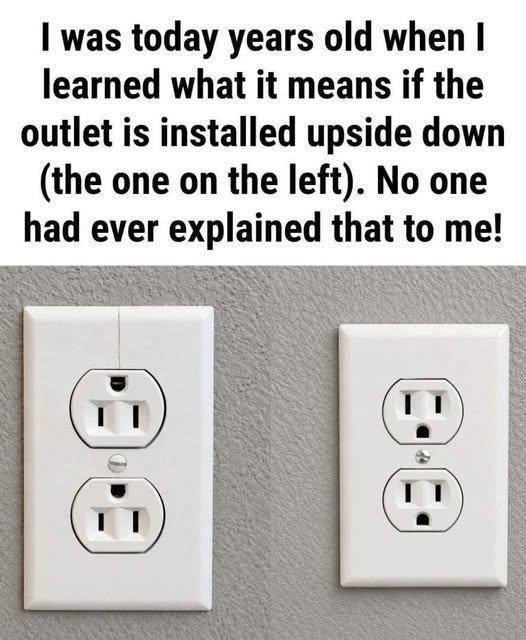
We’ve all seen it—an electrical outlet that looks like it was installed the “wrong” way, with the ground pin hole at the top instead of the bottom. It looks odd, almost like a face frowning at you. Most people assume it was a mistake by a careless builder or a lazy electrician.
But here’s the truth: that outlet isn’t upside down at all. In fact, many electricians and safety experts argue that the “ground up” orientation is the correct and safer way to install an outlet. Here’s why.
The Purpose: Safety Over Style
In the United States, there is no official national standard that mandates one orientation over the other. In most homes, outlets are installed with the ground pin down simply because it looks more like a “face” to many people. This is a convention, not a safety requirement.
However, in many industrial and commercial settings—and increasingly in modern residential construction—the “ground up” orientation is preferred for one simple reason: safety in the event of a failure.
The Ground Pin: Your First Line of Defense
In a standard 3-prong outlet, the ground pin is the longest prong. This is by design. When you plug something in, the ground connection is the first to make contact and the last to break.
By placing the ground pin at the top, you ensure that this crucial safety connection is established before the live “hot” and “neutral” blades can be touched. But the real benefit comes into play when a plug is only partially inserted—a surprisingly common occurrence.
Protection from Foreign Objects
Imagine a plug is slightly loose in the outlet. If the ground pin is at the bottom, the two flat blades (hot and neutral) are exposed at the top. If a small metal object—a coin, a screw, a piece of jewelry, or even a paperclip—were to fall between the plug and the outlet plate, it could easily bridge the hot and neutral slots, causing a short circuit, sparks, or even a fire.
Now imagine the outlet is installed with the ground pin at the top. If that same metal object falls, it will most likely hit the ground pin first. Since the ground pin is designed to safely divert electricity, it would theoretically trip the circuit breaker rather than causing a dangerous short circuit.
As one electrician explained, “If the plug is not fully inserted, the ground pin is the top one and will catch any falling debris, preventing a short circuit”.
A Common Confusion
Despite the safety benefits, the “ground up” orientation is still less common in residential settings. Why?
Aesthetics: Many homeowners simply prefer the look of the ground pin at the bottom. It has become the expected standard.
Tradition: Most electricians are trained to install outlets with the ground down, and they pass that habit on to their apprentices.
Lack of Awareness: Many people simply don’t know that the orientation matters at all.
However, in hospitals, laboratories, and industrial settings, the “ground up” orientation is often required by code or company policy. In these environments, safety is paramount, and the risk of falling debris or loose plugs is higher.
What About the “Frowning Face” Effect?
Some people find the “ground up” outlet unsettling because it looks like a frowning face. But if you look at it from a different angle, it’s actually a safety feature. As one forum commenter noted, “It’s not a frowning face. It’s a smiling face if you’re looking at it from the perspective of safety”.
Does It Actually Matter?
For the average homeowner, the orientation of an outlet is unlikely to make a life-or-death difference. The risk of a foreign object falling into a partially inserted plug is low, but it is not zero.
If you’re building a new home or renovating, you can ask your electrician to install the outlets “ground up” for added peace of mind. If you’re happy with the traditional look, there’s no need to change anything—just make sure your outlets are properly grounded and your GFCI (Ground Fault Circuit Interrupter) outlets are working.
The Bottom Line
That “upside down” outlet isn’t a mistake. It’s a thoughtful design choice intended to prevent accidents. While it may look unusual, the “ground up” orientation prioritizes safety over aesthetics. The next time you see one, you’ll know that it’s not a sign of a careless builder—it’s a sign of a conscious effort to protect you and your home.
Did you learn something new today? Share this article with someone who might be puzzled by their “upside down” outlet!
Disclaimer: This article is for informational purposes only. Always consult a licensed electrician for any electrical work in your home. Do not attempt to modify or install electrical outlets yourself unless you are qualified to do so.
To provide the best experiences, we use technologies like cookies to store and/or access device information. Consenting to these technologies will allow us to process data such as browsing behavior or unique IDs on this site. Not consenting or withdrawing consent, may adversely affect certain features and functions.
Functional
Always active
The technical storage or access is strictly necessary for the legitimate purpose of enabling the use of a specific service explicitly requested by the subscriber or user, or for the sole purpose of carrying out the transmission of a communication over an electronic communications network.
Preferences
The technical storage or access is necessary for the legitimate purpose of storing preferences that are not requested by the subscriber or user.
Statistics
The technical storage or access that is used exclusively for statistical purposes.The technical storage or access that is used exclusively for anonymous statistical purposes. Without a subpoena, voluntary compliance on the part of your Internet Service Provider, or additional records from a third party, information stored or retrieved for this purpose alone cannot usually be used to identify you.
Marketing
The technical storage or access is required to create user profiles to send advertising, or to track the user on a website or across several websites for similar marketing purposes.