The Hardware Store Clerk Who Knew Every Bolt by Heart
There was a time when a trip to the hardware store meant more than just grabbing supplies—it meant tapping into decades of accumulated wisdom. In small towns across America, there existed a special kind of expert: the hardware store clerk who could find any part, solve any problem, and offer advice that came from years of hands-on experience.
The Living Encyclopedia of Tools and Parts
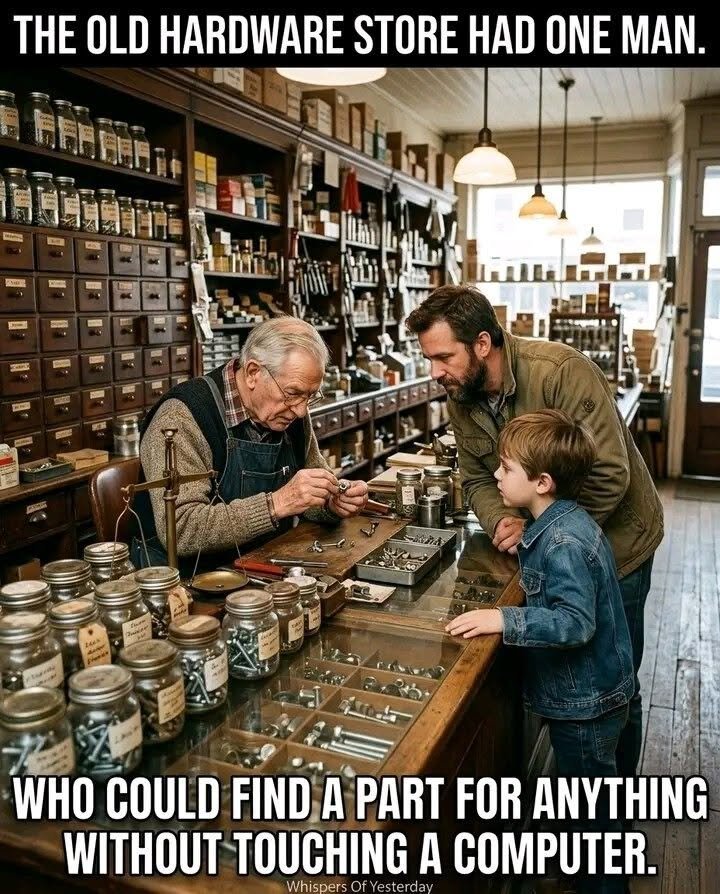
Walk into an old hardware store, and you’d find walls lined with wooden drawers, glass jars filled with screws and bolts, and shelves stacked high with tools of every description. But the real treasure wasn’t the inventory—it was the person behind the counter.
These clerks possessed something that no computer database could replicate: intimate, encyclopedic knowledge of every item in the store. They knew exactly which drawer held the exact size screw you needed, which pipe fitting would work for your specific repair, and often, how to actually do the job you were attempting.
The Value of Specialized Knowledge
What made these hardware store clerks so remarkable wasn’t just their memory—it was their expertise. Specialized knowledge refers to deep understanding in a specific field that makes an individual invaluable to their community
www.facebook.com. These clerks didn’t just sell products; they provided solutions.
When you described your problem, they could:
Identify the exact part you needed without looking it up
Suggest better alternatives you hadn’t considered
Explain the proper way to complete your repair
Share stories of similar jobs they’d helped with before
Warn you about common mistakes to avoid
This level of product knowledge and expertise directly correlated with customer trust and loyalty
nihaa.org. People didn’t just shop at the hardware store—they learned there.
More Than a Transaction: Passing Down Wisdom
The old hardware store didn’t just sell screws, rope, paintbrushes, and tools—it passed down practical knowledge, one conversation at a time
www.facebook.com. Every interaction was an opportunity for learning.
Fathers brought their sons to show them how to choose the right nail for a project. Young couples buying their first home would leave with not just supplies, but confidence. Experienced contractors would stop by to pick up specialty items and swap stories about challenging jobs.
The hardware store was a place where knowledge transfer happened naturally
www.researchgate.net. Skills and wisdom flowed from one generation to the next through patient explanation and genuine interest in helping people succeed.
The Contrast with Modern Shopping
Today, we live in an age of modern retail where convenience and 24/7 availability reign supreme
www.lamasatech.com. You can order any tool or part online, have it delivered overnight, and never speak to another human being. Big box stores and digital shopping options have largely replaced the small neighborhood hardware shop
xaphyr.home.blog.
But something precious has been lost in this transition. When you search online, you get results—but not wisdom. You can read reviews, but you can’t ask follow-up questions based on your specific situation. You can watch a tutorial video, but you can’t get personalized advice tailored to your exact problem.
The hardware store clerk who knew every bolt by heart represented something deeper than retail efficiency. They embodied the value of human expertise, the power of specialized knowledge, and the importance of community connection.
Why We Miss These Places
Small town hardware stores were more than just businesses—they were hubs of social activity and community gathering places
www.facebook.com. Everyone knew your name, your projects, and often your family. The hardware store was where neighbors met, ideas were exchanged, and friendships were forged over shared interests in building and fixing.
These stores instill memories of days gone by, with their distinctive smells of wood and metal, the satisfying clink of hardware in glass jars, and hardwood floors worn smooth by generations of customers
mnprairieroots.com. Stepping inside felt like entering a place where time moved slower and quality mattered more than speed.
The Irreplaceable Human Element
What we really miss isn’t just the convenience of having someone find what we need instantly. It’s the human connection. It’s the patience of someone who takes time to understand your problem. It’s the confidence that comes from knowing an experienced person has steered you in the right direction.
Specialized knowledge and expertise provide enhanced decision-making and efficiency that algorithms simply cannot match
valorglobal.com. A computer can tell you what part number matches your description, but only a human expert can ask the right questions to discover what you really need.
Preserving the Legacy
While traditional hardware stores may be rare today, their legacy lives on in the independent shops that still prioritize expertise and customer service. These remaining treasures remind us that specialized knowledge, skills, and experience are what make professionals truly valuable in any field
scienceofexpertise.com.
Some people are actively documenting and celebrating these places, visiting old hardware stores and capturing the stories of the knowledgeable clerks who still remember where everything is
www.facebook.com. They recognize that these establishments represent more than commerce—they represent a way of life that valued relationships over transactions.
Lessons for Today
The story of the hardware store clerk who could find any part without touching a computer teaches us important lessons:
Expertise matters. Deep knowledge in a specific area creates irreplaceable value
www.linkedin.com. Whether you’re a clerk, a teacher, a doctor, or an engineer, becoming truly knowledgeable in your field makes your contributions more meaningful.
Human connection is priceless. Technology can enhance our lives, but it cannot replace the wisdom that comes from experience and the warmth of genuine human interaction.
Community spaces are vital. Places where people gather to learn, share, and connect form the backbone of strong communities
simplisales.com.
Knowledge should be shared. The clerks who took time to explain, teach, and guide created lasting impact far beyond a single sale.
Conclusion
The old hardware store with its knowledgeable clerk represents more than nostalgia—it represents values worth preserving. In our rush toward efficiency and automation, we must remember that some things cannot be digitized: expertise earned through experience, wisdom shared through conversation, and connections forged through genuine care.
The next time you need a part or face a project, consider seeking out that local expert who still knows their inventory by heart. Support the businesses that prioritize knowledge and service. And perhaps, in your own way, become the kind of expert others can rely on—someone who knows their field so well that no computer is needed to provide the answer.
Because in the end, it’s not just about finding the right bolt. It’s about preserving the human wisdom that helps us build, fix, and create a better world.
To provide the best experiences, we use technologies like cookies to store and/or access device information. Consenting to these technologies will allow us to process data such as browsing behavior or unique IDs on this site. Not consenting or withdrawing consent, may adversely affect certain features and functions.
Functional
Always active
The technical storage or access is strictly necessary for the legitimate purpose of enabling the use of a specific service explicitly requested by the subscriber or user, or for the sole purpose of carrying out the transmission of a communication over an electronic communications network.
Preferences
The technical storage or access is necessary for the legitimate purpose of storing preferences that are not requested by the subscriber or user.
Statistics
The technical storage or access that is used exclusively for statistical purposes.The technical storage or access that is used exclusively for anonymous statistical purposes. Without a subpoena, voluntary compliance on the part of your Internet Service Provider, or additional records from a third party, information stored or retrieved for this purpose alone cannot usually be used to identify you.
Marketing
The technical storage or access is required to create user profiles to send advertising, or to track the user on a website or across several websites for similar marketing purposes.