What Is That Weird Toothed Part on Kitchen Scissors For? (And 4 Brilliant Hacks You’ve Been Missing)
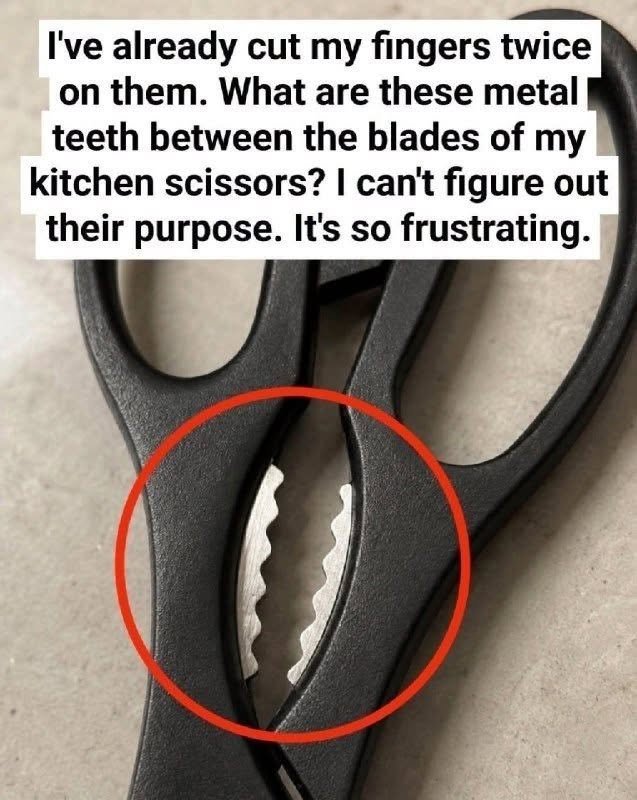
If you’ve ever looked closely at your kitchen scissors, you’ve probably noticed a small, ridged, or toothed section between the handles. And if you’re like most people, you’ve probably wondered: What on earth is that for?
You’re not alone. Many people don’t even recognize this part as functional. Some have even cut their fingers on it, assuming it’s a strange design flaw. But that little metal jaw isn’t just for decoration—it’s actually a built-in multi-tool that can make your kitchen tasks much easier.
First: What Is This Toothed Part?
That notched, toothy section isn’t meant for cutting—it’s designed for crushing, gripping, and holding things in place. It’s usually called a “jar opener,” “nutcracker,” or sometimes even “bone cracker” depending on the brand. Essentially, it’s a gripping device that enhances traction and control when your hands just aren’t cutting it.
Here’s how to put it to work with four brilliant hacks you’ve probably been missing.
Hack #1: Open Stubborn Jar Lids and Bottle Caps
This is the most common use. That stubborn jam jar that won’t budge? The vacuum-sealed lid that refuses to leave? Your kitchen scissors can come to the rescue.
How to do it: Close the scissors enough that the teeth simply touch, then slide the jar lid inside that ridged area until it’s snug. One hand holds the scissors, the other twists the jar. The grooves give you traction, and the shape gives you even pressure—no more wrestling with a slippery lid. This also works for small bottle caps on soda bottles, cooking sauces, and twist-off beer caps. The length of the scissor handles gives you far more torque than your bare hand.
Hack #2: Crack Nuts Without a Fancy Gadget
Don’t have a nutcracker? No problem. Whether it’s walnuts, pecans, hazelnuts, or pistachios, your kitchen scissors can do the job.
How to do it: Place the nut gently in the toothed area and squeeze the handles slowly until you hear the shell crack. Don’t go full Hulk—you’ll crush the nut inside. Rotate the nut and apply pressure again until you can peel the shell off. It works in a pinch, just take it slow.
Hack #3: Grip Poultry Bones for Clean Cuts
When you’re deboning or trimming poultry, the notches help grip and hold bones steady so you can make clean cuts around them.
How to do it: Place the bone in the ridged portion and apply steady, controlled pressure. This is especially useful for chicken wings, thighs, or breaking down a whole bird. The teeth prevent the shears from sliding or slipping. Just be mindful: if your scissors aren’t heavy-duty poultry shears, don’t try this with your $5 grocery-store pair—you could ruin them and injure yourself.
Hack #4: Crush Garlic and Strip Herbs
Instead of using the flat side of a knife, simply place a garlic clove under the toothed area and press down gently. The teeth crush the garlic without turning it into mush—perfect for releasing flavor fast. You can also use the notch to grip herb stems like rosemary or thyme to strip leaves quickly and easily.
A Word of Caution
Regardless of what you’re using your kitchen scissors to open, always keep safety in mind. Always hold scissors with their blades pointed upward so you never pull up on a lid or bottle cap. Instead, always twist, and keep the blades as far away from your face as possible.
If you keep cutting your fingers on the teeth (and you’re not alone—they’re positioned precisely where your fingers naturally slide when cutting with force), try gripping the handles farther back, away from the hinge. You can also wrap the metal teeth with a few tight passes of electrical tape or self-adhesive silicone tape to blunt the bite without affecting the function
To provide the best experiences, we use technologies like cookies to store and/or access device information. Consenting to these technologies will allow us to process data such as browsing behavior or unique IDs on this site. Not consenting or withdrawing consent, may adversely affect certain features and functions.
Functional
Always active
The technical storage or access is strictly necessary for the legitimate purpose of enabling the use of a specific service explicitly requested by the subscriber or user, or for the sole purpose of carrying out the transmission of a communication over an electronic communications network.
Preferences
The technical storage or access is necessary for the legitimate purpose of storing preferences that are not requested by the subscriber or user.
Statistics
The technical storage or access that is used exclusively for statistical purposes.The technical storage or access that is used exclusively for anonymous statistical purposes. Without a subpoena, voluntary compliance on the part of your Internet Service Provider, or additional records from a third party, information stored or retrieved for this purpose alone cannot usually be used to identify you.
Marketing
The technical storage or access is required to create user profiles to send advertising, or to track the user on a website or across several websites for similar marketing purposes.